- Get Involved
- BBYO Near You
- Summer Experiences
-
International Convention
International Convention
-
AZA & BBG Movement
AZA & BBG Movement
- About BBYO
Spotlight
The Untold Story of Shanghai’s AZA Chapter
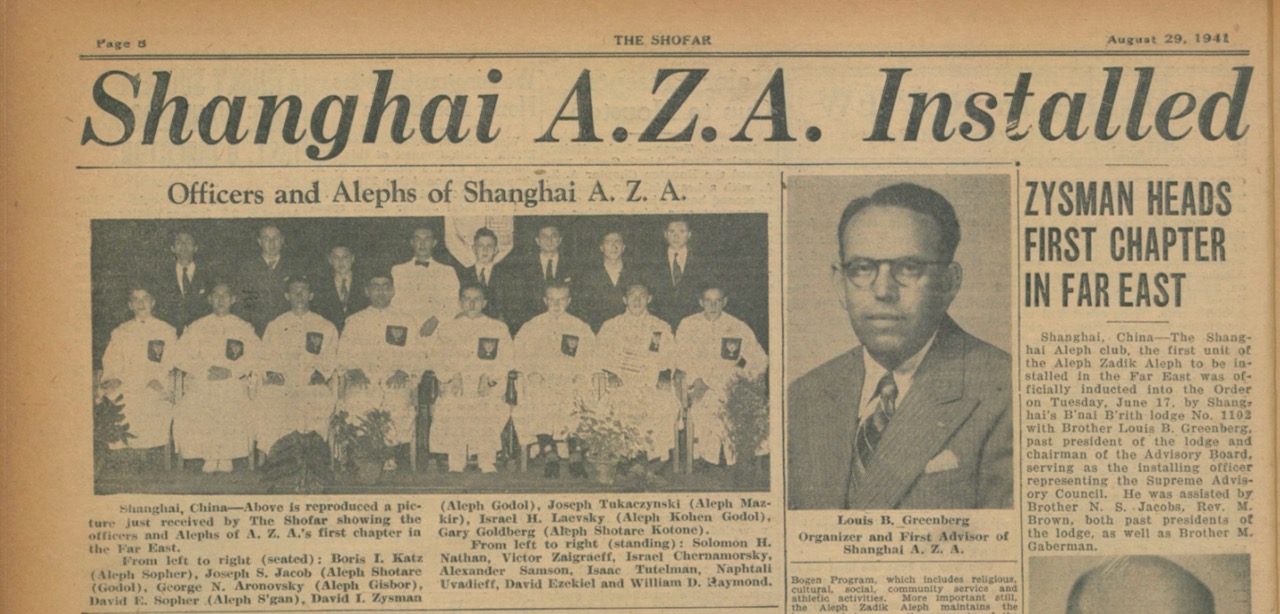
Shanghai, the most economically prosperous city in China, was once home to 22,000 Jewish refugees during the Second World War.
In 1938, as Nazi Germany dramatically increased its persecution of Jews, fleeing Europe became the way out for many European Jews. For Jewish refugees fleeing Europe, one major problem occurred: there was nowhere to flee to. After the failed meetings of the Evian Conference, most countries were not ready to open their borders for the fleeing Jewish Refugees. One place arose as a place of safety, and that was Shanghai. Shanghai, the economic capital of the Far East, has been under the influence of many foreign powers, such as the British and the United States, since 1863, the establishment of the International Settlement. Shanghai in 1937 was invaded and occupied by the Japanese. This unique status made Shanghai an open port city, which meant that it technically did not require a permit to enter. Shanghai became a safe haven for Jewish refugees fleeing nazi persecution.
With the influx of around 20,000 Jewish refugees, stores, schools, synagogues, and clubs were starting to be established. This also included the establishment of Shanghai’s own AZA chapter.
Shanghai AZA was installed on June 17, 1941, in Shanghai, China. The chapter was led by David L. Zysman, who served as the first Aleph Godol of Shanghai.

In the installation address by David L. Zysman, he states, “You have seen displayed before you more than the mere installation of a set of new officers—You have seen more than the mere unfurling of the Aleph Zadik Aleph banner in the Far East—You have actually been present at the setting up of a new and vital milestone in the history of Far Eastern Jewry—You have heard a true cross-section of Jewish young men taking the solemn oath to maintain the principles for which their ancestors died and their brethren were persecuted and exiled and for which the world is wading in blood today.”
For members of Shanghai AZA, being the first-ever chapter in the Far East, they were embarking on a brand new journey. For many of these young men, being persecuted and forced to leave their homes was already an immense hardship. They then had to move halfway around the world to a completely foreign destination, Shanghai, China. Throughout all of these difficulties, the Shanghai Jewish refugees never gave up; they kept on pushing. They demonstrated immense resilience, no matter how hard life was going to be. The Jewish refugees of Shanghai remind us of the strength we can all have, no matter the challenge, and the importance of community.
Today, BBYO not only has an active chapter in Shanghai, ZhenJews BBYO, but its Asia Pacific Region is a new, fast-growing region providing Jewish teens with the opportunity to connect to their Jewish identity. Making sure Jewish teens around the world, no matter where they call home, can have their own meaningful Jewish experience.
All views expressed on content written for The Shofar represent the opinions and thoughts of the individual authors. The author biography represents the author at the time in which they were in BBYO.
Explore More Stories

Identity

Taking The Risk
A personal reflection on what it means to risk starting over in order to feel safe and proud being Jewish.
Identity

The Importance of Traditions
From pancakes to paperclips, traditions build connections and friendships.

Opinion

Seatbelt Stories
Giving rides to underclassmen in BBYO, and in general, hits different. Why?